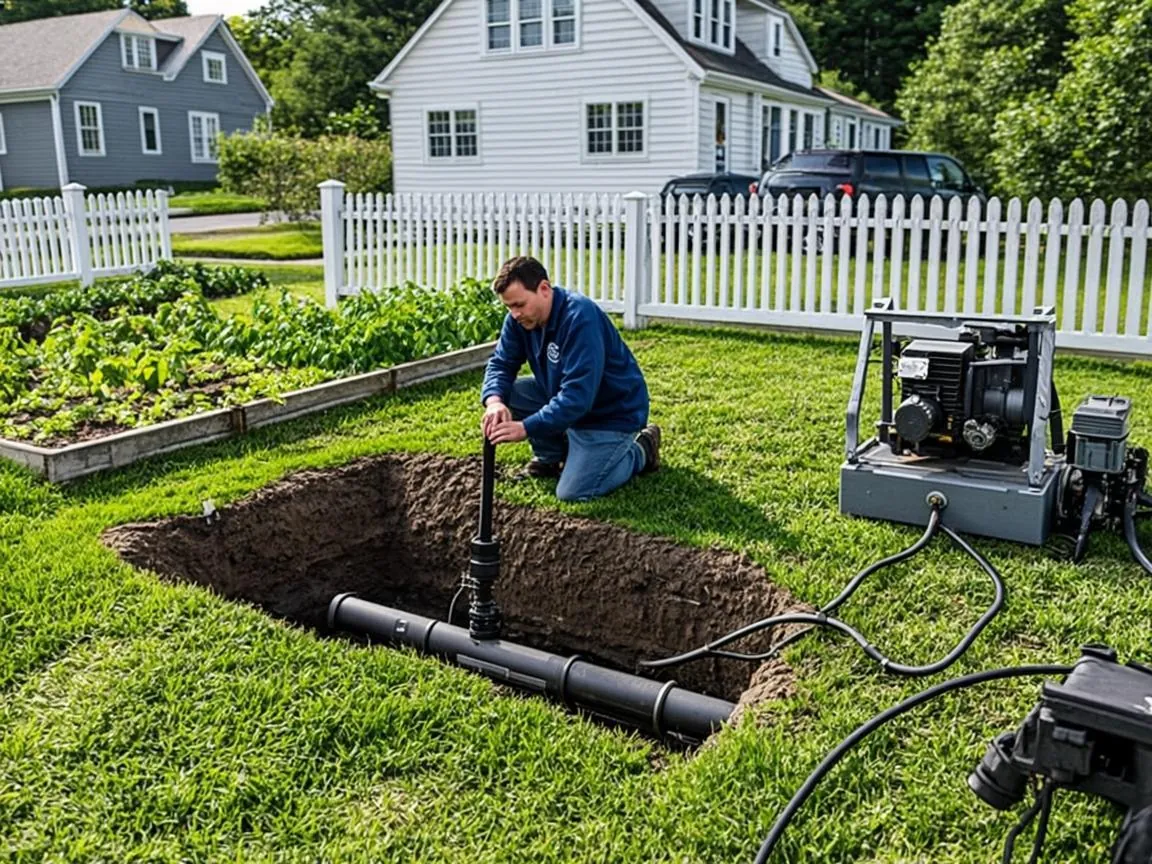
When a sewer line has collapsed, been crushed by ground movement, or corroded past the point where a liner can hold, the traditional answer was an excavator and a trench straight through your yard. Pipe bursting is the modern answer: a hydraulic winch pulls a bursting head through the failed pipe, fracturing it outward into the surrounding soil while simultaneously pulling a brand-new high-density polyethylene (HDPE) pipe into the exact void it leaves behind. The old pipe is destroyed in place; the new pipe takes its position; your driveway, gardens, and stone walls never meet a shovel.
Beverly Sewer & Drain performs pipe bursting replacement in Beverly, MA for the pipes that lining cannot save. If your camera footage shows a collapsed section, a deformed run, or a lateral you have been told needs full excavation, call (978) 286-4881 for a second opinion. There is a good chance the answer is two small pits instead of one long trench.
What Is Pipe Bursting and How Does It Work?
The process runs from two small access pits, one at each end of the failed run: a launch pit at the house or cleanout end, and a receive pit at the street connection. A steel cable or rod string is threaded through the old pipe between the pits and attached to a bursting head, a conical steel tool wider than the host pipe itself, with the new HDPE pipe chained behind it.
As the hydraulic winch pulls the cable, the bursting head advances through the old pipe, splitting or shattering it outward into the soil. The debris stays in the ground, becoming part of the backfill; the new HDPE follows directly behind the head, sliding into the space the old pipe occupied. The result is a complete, continuous, jointless replacement pipe following the original's path, installed in a single pull that commonly takes hours, not days. For a typical residential lateral, the entire project, pits, pull, connections, and verification, finishes in one to two days with the surface restored behind it.
Pipe Bursting vs. Trenchless CIPP Lining
Both are trenchless, and both leave your landscape intact, but they solve different failures. A cured-in-place liner (CIPP) installs a new structural wall inside the old pipe, which requires the old pipe to still hold its essential shape: a liner needs a host. Pipe bursting installs a completely new pipe through the old one, and does not care what condition the host is in. The comparison below shows where each method wins:
| Condition | CIPP Lining | Pipe Bursting |
|---|---|---|
| Pipe still round and continuous | Ideal: the liner's designed environment | Possible, but lining is usually the lower-cost fix |
| Collapsed or crushed section | Not installable; no host to line | The signature application: fractures and replaces in one pull |
| Pipe deformed, offset, or partially belled | Often cannot pass or conform | Handled: the head follows the original path regardless of deformation |
| Need to increase pipe diameter (upsizing) | Cannot exceed host diameter | The only trenchless method that can upsize, e.g. 4-inch to 6-inch |
| Root-invaded but structurally intact joints | Excellent: seals every joint at once | Works, but destroys a host that lining could have saved |
| Back-pitched or severely sagging runs | Cures into the same sag | Limited: severe grade failures still need excavation and re-sloping |
Mixed conditions are common, and so are hybrid projects: burst the collapsed section, line the sound remainder, and restore flow at a total cost well below full excavation. The table is a map, not a menu; your pipe's footage always has the final word, and we walk you through it on screen before any method is priced.

Advantages of HDPE Pipe Systems
The pipe that bursting installs is not a compromise; it is an upgrade over everything it replaces, and the material is the reason:
- Fusion-welded and jointless. HDPE sections are heat-fused into one continuous run with zero joints, which means zero entry points for the tree roots that destroyed the clay line it replaced.
- Root-proof and corrosion-proof. The smooth polymer wall gives roots nothing to probe and gives wastewater chemistry nothing to corrode, for a design life measured in generations rather than decades.
- Impact and flex tolerance. HDPE flexes with Essex County freeze-thaw ground movement instead of cracking the way rigid clay and cast iron do, which is precisely the failure mode that fills our winter emergency calendar.
- Upsizing capability. Because the burst cavity exceeds the host diameter, a chronically undersized 4-inch line can be replaced at 6 inches where flow demands it, something no liner can offer.
- Superior hydraulics. The interior surface has a lower friction coefficient than clay, cast iron, or concrete, so the same diameter carries more flow with less scaling potential.
How Many Pits Does Pipe Bursting Need?
Two: one launch pit and one receive pit, typically a few feet across each, positioned at the ends of the run being replaced. That is the entire excavation footprint for a project that replaces every foot of pipe between them. Compare that with the alternative, a continuous open trench the length of the yard through lawn, irrigation, gardens, and possibly driveway, and the difference is measured in both dollars and disruption: trench restoration routinely adds thousands to a replacement project, while the two pits are backfilled and surface-restored at the end of the same visit sequence.
The pits matter for permitting, too: work that reaches the city connection still follows Beverly's permit process and Dig Safe mark-outs, both of which we file and coordinate as part of the quoted project. You approve one engineered number, and the next time you think about your sewer line should be never.
What Does Pipe Bursting Cost in Beverly?
Bursting typically lands between full lining and open-trench replacement on the invoice, with the decisive advantage that it includes a complete new pipe in situations where lining simply cannot serve. Open-trench replacement for a residential lateral generally runs $5,000 to $12,000 or more once restoration is counted; bursting usually prices meaningfully below that range for comparable runs, because the excavation and restoration line items shrink to two pits. Every project is quoted from the camera inspection as a single engineered price: access, materials, execution, verification, and permit coordination in one confirmed number.
When a burst is not the right call, we say so: isolated damage belongs on the non-invasive trenchless pipe lining page, grade failures belong on the traditional sewer line excavation page, and the full diagnostic and maintenance picture lives on Beverly sewer line repair & drain cleaning. The footage decides, and the footage is yours to watch.