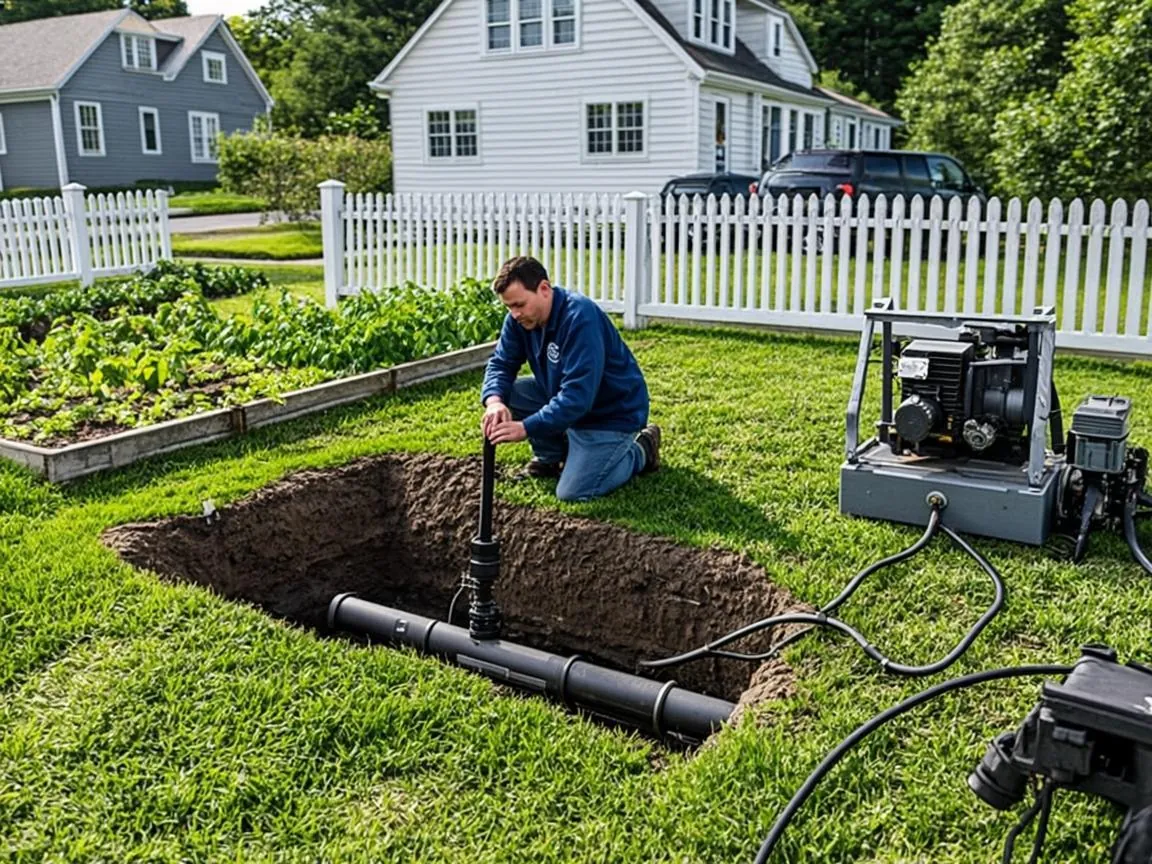
When a scope camera reaches a section of pipe that has fully collapsed — the barrel crushed shut, soil and wastewater meeting where the pipe wall used to be — most trenchless conversations end. Cured-in-place lining needs a host pipe to line inside; a collapsed line has no host. For decades the only answer was an open trench from house to street. Pipe bursting changed that: it is the one trenchless method that replaces a destroyed pipe rather than rehabilitating it, and it does so by destroying the old pipe on purpose.
The Process, Step by Step
- Two small pits, not one long trench. An entry pit is opened at one end of the run (often at the cleanout or foundation wall) and an exit pit at the other (often at the city tap). Each is roughly four feet by six feet — a fraction of the surface a trench would claim.
- The bursting head advances. A pneumatic or hydraulic bursting tool is winched through the old pipe. Its conical head is physically larger than the host pipe's outer diameter, so as it advances it fractures the brittle old clay or cast iron outward into the surrounding soil.
- New pipe follows the head. Directly behind the bursting head, a continuous run of high-density polyethylene (HDPE) pipe is pulled into the cavity the fractured fragments just vacated. The winch keeps steady tension; the new pipe never drags through unsupported soil.
- Fused joints, zero seams. HDPE sections are heat-fused into one continuous flexible run before installation. There are no joints to separate, no gaskets to invade, no bell-and-spigot geometry at all.
- Reconnect and verify. House connections and the city tap are reconnected to the new pipe, the pits are backfilled and restored, and a post-installation camera pass documents the finished line.
Why HDPE Is the Right Material for This Job
HDPE earns its place in the ground three ways. First, the fusion: a butt-fused HDPE joint is chemically and mechanically the same as the pipe wall, which is why root resistance is absolute — our guide on root penetration of modern pipe materials covers the science. Second, flexibility: the fused run bends around gentle curves and rides out frost heave without cracking, a meaningful trait in New England's freeze-thaw cycles. Third, longevity: fused HDPE carries design-life ratings from 50 years to a century, with smooth interior walls that resist scaling and grease adhesion better than the iron it replaces.
When Bursting Beats Lining — and When It Doesn't
Pipe bursting owns three scenarios. Collapsed or crushed sections: no host pipe, no lining; bursting is the only trenchless answer. Severe offsets and grade failures: where the old pipe must leave the ground entirely, bursting removes it from the equation and re-beds the new run as it pulls. Upsizing: the same pull that replaces a 4-inch clay line can install a 6-inch HDPE line, doubling flow capacity — a common ask when additions or in-law units increase load. What bursting is not is a fix for bellies that need true re-grading along a specific station, and extremely shallow runs directly beneath structures can fall outside its displacement envelope. In those cases our traditional excavation service remains the honest recommendation, permits and restoration included.
The Yard Impact: Two Pits vs. One Trench
The cost story of bursting is really a restoration story. An open trench across a Beverly lot cuts through lawn, irrigation, plantings, and often a driveway or stone wall, and the restoration line item can rival the pipe work itself. Bursting confines the digging to two pits — the rest of the property never sees a machine wider than a walk-behind. Projects routinely finish in one to two days, and the landscape above the new line stays exactly where it was. Our pipe bursting replacement service includes the pre-construction locate that maps utilities and clearances before the first pit is opened; for a broader comparison of methods and prices, see trenchless vs. traditional sewer repair.
Quick Answers
How long does a pipe-bursting HDPE replacement last?
Fused HDPE pipe carries a design life well beyond 50 years, commonly quoted at 100. The heat-fused joints are chemically the same material as the pipe wall — there is no gasket, mortar, or solvent seam for roots or groundwater to exploit.
Does pipe bursting damage nearby utilities or structures?
The fracturing energy displaces soil roughly a pipe diameter outward, which is why pre-locate surveys matter. Maintained clearances of three feet or more from gas, water, and conduit lines keep neighboring utilities unaffected, and displacement effects are negligible at typical residential lateral depths.
Is pipe bursting cheaper than open-trench excavation?
The pipe-line work is comparable per foot; the savings come from restoration. Bursting needs only an entry and exit pit instead of a continuous trench, so driveways, lawns, walls, and plantings survive — often trimming thousands from the total project cost and cutting the schedule to a day or two.
Collapsed Line? Skip the Trench.
Pipe bursting replaces destroyed laterals with fused HDPE through two small pits. Free pre-construction locate and flat-rate pricing.