The bottle promises a five-minute fix. The bottle is not lying about the five minutes; it is lying about the fix. Chemical drain cleaners and old New England plumbing have a specific, ugly relationship, and this post explains why the second bottle is always a worse idea than the first, and what to do when the clog is real.
What Is Actually in the Bottle
Heavy-duty drain openers rely on powerful alkalis (typically sodium hydroxide, sometimes with sodium hypochlorite) or strong acids. The reaction that dissolves hair and grease is genuinely exothermic: the mixture heats water in the standpipe to near-boiling as it works. That chemistry is indiscriminate. It attacks hair and grease, and it attacks metal, enamel, gaskets, and older soldered or threaded joints with the same energy, just more slowly.
The Cast Iron Problem Specifically
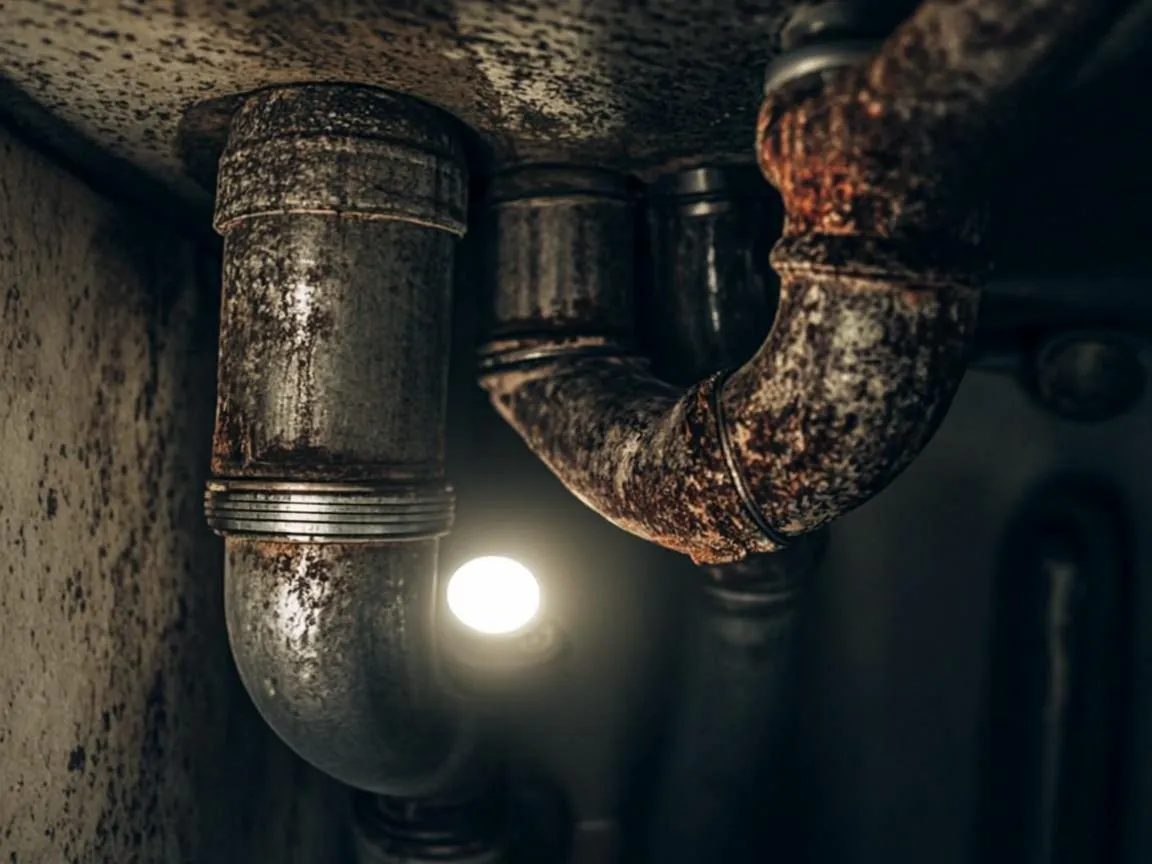
A century of Greater Boston and North Shore homes ran on cast iron drains, and many still do below the fixtures. Cast iron's enemy is corrosion, and caustic cleaners accelerate it in two ways: the alkali attacks the graphite and iron matrix directly over repeated exposures, and the heat cycling stresses the scale layer that passivates older pipe. A line that was rough-but-sound becomes rough-and- thinning. The pipe does not fail the day you pour; it fails a few winters earlier than it otherwise would have, which is the least satisfying way to lose a bet.
Why They Fail on Main Line Clogs Anyway
Even granting the bottle its chemical powers, a main line clog defeats it geometrically. The standing blockage in a main is rarely one substance: it is a composite of roots, grease layers, and solids packed over feet of pipe. The chemical reaches only the nearest face, the heat dissipates into gallons of water, and the reaction quits long before it penetrates. What you get is a hole the width of the bottle's patience, which is the same thing a $150 snake would have left, minus $30 and with a newly irritated pipe.
What to Do Instead, by Situation
- One slow fixture, first offense: a plunger or a hand-crank hair snake. Mechanical, local, done.
- Kitchen line, recurring: that is a grease film, and it needs hydro-jetting, which strips the wall instead of chewing it.
- Several fixtures at once: main line territory. Camera first, then the right machine; start at our video locating and camera inspection page.
- Active backup: stop pouring anything, keep people away from the water, and call the 24/7 emergency crew.
The Enzyme Alternative, Honestly
Bacterial enzyme treatments are gentler and slower: they digest organic film over hours and are safe on metal and septic systems alike. As a maintenance habit in a grease-prone kitchen line they earn their shelf space. As a rescue for a real clog they are decorative, and no enzyme on any shelf will touch a root. Chemical or biological, the pattern holds: products manage symptoms, machines fix pipes.
Quick Answers
Do chemical drain cleaners damage cast iron pipes?
Repeated caustic exposures attack iron and its protective scale layer, and the heat cycling stresses already-thin walls. One use rarely kills a pipe; a decade of them reliably shortens its life and leaves pitting a camera can show you.
Why doesn't drain cleaner work on a main line clog?
Main line blockages are feet of composite material, not a surface film. The chemical reaches one face, the reaction quenches in cold standing water, and the result is a small hole in a big clog, same as a snake would leave.
Skip the Bottle. Fix the Pipe.
Camera first, then the machine the footage calls for. Free quotes and none of the corrosion.